

Why Urban Noise Control Matters
Traffic noise is a major problem in all large cities and the sound propagation in the urban context is reinforced by the multiple reflections on the building façades.
The surface acoustical characteristics (e.g. referred to roads, pedestrian traffic areas, building facades, building surfaces in general) affect the noise propagation in the urban environment.
For developers, architects, and building owners, addressing traffic noise control is no longer optional, it’s essential for creating comfortable and sustainable buildings.
At Pertac Resources, we focus on practical, science based noise reduction solutions that begin at the urban level and extend into the built environment.
How Noise Spreads in Urban Environments
Understanding noise propagation is key to reducing its impact.
In cities, sound reflects off hard surfaces such as roads and building façades. These reflections amplify noise, especially in areas with:
- Narrow streets
- Tall buildings
- Highly reflective materials like concrete and glass
This is why acoustic design plays a crucial role in controlling environmental noise.
Through better outdoor design and management such as green areas, porous asphalt, and speed control or building refurbishment actions like acoustic plaster and absorbing shading devices, we can increase surface absorption.
This approach helps mitigate environmental noise pollution. As a result, it reduces sound levels near building facades across their entire height.
Effective Urban Noise Reduction Strategies
Reducing noise at the source is one of the most effective approaches to improving indoor acoustic comfort. By addressing how noise is generated and transmitted in urban environments, cities can create quieter and more livable spaces for residents and building occupants.
Green Infrastructure and Landscaping
Vegetation such as trees, shrubs, and green walls can absorb, scatter, and diffuse sound waves, helping to reduce overall noise levels. In addition to their acoustic benefits these natural elements improve air quality and enhance urban aesthetics, making them a multifunctional solution for environmental noise mitigation.
Low Noise Road Surfaces
The use of special materials like porous asphalt or rubberized pavement can significantly reduce tyre to road interaction noise. These surfaces are designed to minimize vibration and sound generation, particularly at higher speeds, making them an effective strategy for reducing traffic related noise in dense urban areas., contributing to better traffic noise reduction.
Traffic Management
Implementing measures such as lower speed limits and optimized traffic signal timing can help decrease noise emissions. Smoother traffic flow not only reduces engine and braking noise but also contributes to safer and more efficient transportation systems.
Acoustic Facade Design
Thoughtful facade design plays a crucial role in limiting noise intrusion into buildings. Incorporating sound absorbing and diffusing materials such as acoustic plaster, perforated panels, or external shading systems can reduce sound reflection and transmission. These strategies improve indoor acoustic comfort while maintaining the visual and functional performance of the building envelope.
A key principle in building acoustics is simple: Lower outdoor noise leads to quieter indoor environments.
When sound levels at the building façade are reduced:
- Less noise penetrates walls and windows
- Indoor environments become more comfortable
- Dependence on costly interior retrofits is reduced
This makes outdoor noise control strategies a highly efficient solution for long term performance.
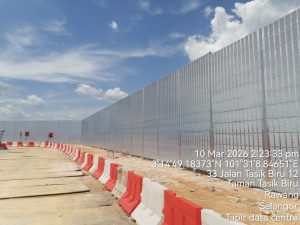
Temporary Metal Noise Barrier Wall At Elmina Data Centre, Selangor
Using Acoustic Simulation for Better Design
At Pertac Resources, we use advanced acoustic simulation tools to model and predict noise behaviour in real world environments.
Using a three dimensional simulation model, we quantify the influence of various configurations and the potential impact of acoustic treatment solutions through noise propagation calculations in urban environments.
Our approach includes:
- Simplified models to study general trends
- Detailed 3D simulations based on actual site conditions
- Scenario testing for different materials and layouts
In the first stage of the research, the analysis of a simplified model is conducted to evaluate the influence of noise on the buildings facades, based on a simplified geometry of the urban environment and of the surface acoustic features.
The same analysis is validated by means of a more detailed model, corresponding to the configuration of an existing built area, to verify if the analyses performed by means of the simplified model can be extended to more complex layouts.
Successively, calculations are developed to quantify the noise levels that occur with different acoustic (absorption of facades, soil, asphalt, or green elements) and the existing configuration (road width, buildings height, presence of balconies, etc.) characteristics, to show the potential reduction given by some proposed acoustic treatment.
Solutions that can lead to a more significant reduction of the noise in correspondence of the facades are then discussed.
This allows us to optimise noise control solutions before construction begins.
Key Factors That Influence Urban Noise Levels
Through modelling and analysis, we evaluate how different elements can affect noise reduction, including:
- Building height and density
- Road width and layout
- Balcony and façade design
- Surface materials and finishes
- Integration of green elements
By understanding these factors, we can recommend high impact, cost effective interventions.
Designing Quieter Cities for Better Living
Excessive noise isn’t just an annoyance, it’s a health and well being issue. Effective environmental noise control improves:
- Productivity in workplaces
- Comfort in residential spaces
- Overall liveability
By integrating acoustic consideration into early design stages, cities can become quieter, healthier, and more sustainable.
Conclusion: A Smarter Approach to Noise Control
The future of urban noise reduction lies in smarter, more integrated design strategies. By addressing noise at the source and improving outdoor environments, we can significantly enhance indoor acoustic comfort.
At Pertac Resources, we help our customers achieve these outcomes through expert led analysis, innovative design, and data driven solutions.